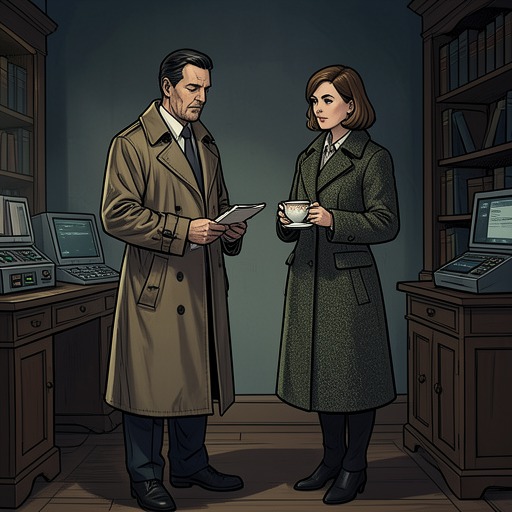
Sir Henry Clithering
A Murder Is AnnouncedSir Henry Clithering is a former Commissioner of Scotland Yard whose experience and admiration for Jane Marple make him an important link between the local investigation and a wider tradition of detective work. He recognizes the unusual promise of the Little Paddocks case, welcomes Jane Marple’s involvement, and helps frame the investigation around a central question: what did the witnesses truly see?
Identity and Introduction
Sir Henry is presented as a tall, distinguished-looking elderly man. When the Chief Constable calls him into the office to discuss the case, he arrives with slightly raised eyebrows and immediately resists being described as blasé. His manner combines professional composure with a lively interest in an investigation that may prove more puzzling than an ordinary police matter.
His assessment of Chipping Cleghorn shows an awareness of the village’s social character. He imagines its retired residents and older women gathering to investigate the murder announcement, and regrets that his own especially gifted acquaintance is not there to pursue it. The affectionate nickname he gives Jane Marple is teasing, but his underlying judgment is serious: he regards her as a detective of exceptional natural ability.
Role in the Investigation
The preliminary medical report leaves open whether Rudi Scherz’s revolver was discharged deliberately or accidentally. It records a close-range discharge but does not establish which explanation is correct. Sir Henry emphasizes the practical consequence for the investigation: Craddock must question the witnesses carefully and establish exactly what each one saw. He is interested not only in the testimony offered, but in the gaps and distortions that can arise during a moment of excitement and strain.
That concern proves especially apt in the Little Paddocks hold-up. Craddock initially maintains that the witnesses all saw a masked man with a revolver and a torch, though their accounts differ over the words used. Jane Marple points out that the hall and landing were unlit: if the intruder shone a powerful torch into the room, the occupants could not have made out the figure as clearly as they later claimed. Craddock confirms that he has tested the lighting conditions. What witnesses remembered as a direct view could instead have been reconstructed after the lights came on.
Sir Henry’s insistence on exact observation therefore anticipates the investigation’s distinction between what people experienced in the moment and what they later believed they had seen. Jane Marple identifies Rudi as the likely fall guy; the apparent consensus among witnesses does not make their account of the masked intruder reliable.
Relationship with Jane Marple
Sir Henry’s admiration for Jane Marple is both personal and professional. When Rydesdale reads her letter offering assistance, Sir Henry recognizes her name at once and is delighted that she is in Medenham Wells at the right time to become involved. He welcomes the prospect of introducing her to the investigation, while Rydesdale agrees to meet her over lunch at the Royal Spa Hotel. Craddock, by contrast, remains sceptical of Sir Henry’s enthusiasm.
That contrast sharpens when Craddock tests Jane Marple by stating the witnesses’ apparent certainty about the masked man. She catches the flaw in the claim, and Craddock recognizes that she has understood the point he was testing. Sir Henry’s confidence in her is thus borne out in the investigative work itself: her apparently gentle manner does not prevent her from noticing what the testimony cannot establish.
Narrative Significance
Sir Henry helps establish the story’s standard of evidence before the solution is reached. The medical report cannot decide whether the shooting was accidental or deliberate, and the witnesses’ accounts cannot establish that they saw the intruder’s features in the darkness. In both instances, an account must be measured against what the physical circumstances permit. His attention to observation and omission complements Jane Marple’s insight and Craddock’s practical testing of the scene, underscoring how the case turns on the difference between a confident recollection and a verifiable perception.